Showing posts with label birth boot camp. Show all posts

Thursday, June 25, 2015

Birth Boot Camp: Class 8

Class 8 – The Fog of War: Keeping a Clear Head in Labor Fog of War: phrase – term used to describe the uncertainty and disorientation experienced in the thick of battle. The Fog of War is about all the things you can do to avoid a cesarean section and when they are actually necessary. You will also be prepared for unexpected circumstances that may come up during labor or birth.

Legitimate Reasons for a C-Section:

1. Placenta Previa
2. Placental Abruption
3. Prolapsed Cord
4. True Fetal Distress
5. Transverse Baby
6. True CPD
7. Bicornuate Uterus

Situations that are Commonly C-Section but are not always necessary:

1. Twins
2. Breech Baby
3. Transverse (often turn last minute)
4. Herpes
5. CPD
6. Previous c-section

Notes from our instructor:

The focus of class 8 is learning the reasons for C-sections and ways you can avoid them. As your instructor made clear, carefully choosing a care provider is one of the most important things you can do.
Let’s look at some research on some common things that can lead to C-section.
This article, written by a midwife, offers research links and lots of valuable information concerning the “measure of progress” in labor. She talks about a common diagnosis for C-section: failure to progress.
This article, by the same midwife, discusses real safety and risk of waters breaking and waiting for baby to be born. Don’t forget that for most women, water breaks towards the end of labor.
Here you can learn about the amazing ways that the bag of water protects the baby and why you might want to avoid breaking it for no reason.
Here is a great article on the posterior baby. Though we often fear this happening, sometimes there is a reason. Women do often naturally birth their posterior babies, but sometimes their labor patterns look a little different than those of anterior babies. This is still a normal position, just less common.
Sometimes babies DO pass meconium (their first stool) while still in utero. This article covers meconium, what to do, and what not to do.
(All of the above mentioned articles have footnotes to research if you are feeling adventurous enough to do some additional reading).
C-sections ARE sometimes necessary, but being knowledgeable will help you navigate avoiding one and knowing if one is necessary for you.
Relaxation Exercise: Visualizing Birth
“The Fog of War: Keeping a Clear Head in Labor” dealt with a variety of situations you may (or may not) encounter during labor or birth. File this information away and retrieve it if it becomes necessary. The mind is very powerful. “Visualizing Birth” will help fine-tune the vision of what you hope for in your own birth.

Wednesday, June 24, 2015

Birth Boot Camp: Class 7

Class 7 – Cadence: The Sights and Sounds of Natural Childbirth Cadence: noun – a work song sung during physical activity or training. The moment you’ve been waiting for – the birth of your baby! Cadence: the Sights and Sounds of Birth will tie together the birth videos viewed throughout the class series, giving you a clear picture of birth. Water birth and optimal positioning for mom and baby will be covered. Replace fear with joy and anticipation of meeting your baby for the very first time.

Pushing Positions:

1. Sitting upright, leaning on partner: makes resting between contractions easier
2. Pushing w/one leg raised: help release baby shoulder, mom could catch baby
3. Birthing Stool: mom may feel more in control
4. Side-lying: allows for rest, less likely to tear, mom may feel less in control
5. Squatting: widens pelvis by 30%, uses gravity
6. Sitting upright, leaning on partner: birth tub, great for short women,
7. Hands and knees: good for shoulder dystocia or larger baby, relives back pressure, less likely to tear

Notes from our instructor: 


The pushing part of labor is often what people imagine when they think of birth. In reality, pushing comes at the end of the intense LABOR of labor and is often longer and quite different than you may see portrayed on television. As with pregnancy, labor sensations, and due dates, everybody experiences this stage a little differently.

This article gives some helpful tips and answers to frequently asked questions concerning this very exciting time of birth when you are so close to meeting your baby.

This article looks at the practice of episiotomy and if it is merited. (Hint, it usually isn’t!) It also offers links at the bottom of the page if you would prefer to read the research yourself. The illustrations are helpful in comprehending what is really happening to a woman’s vagina in this often discussed cut. The likelihood of episiotomy varies greatly regionally and from one provider to another. Find out what is common with yours. You won’t regret it.

Many women are concerned with tearing of the perineum. This article has some information regarding things that can help prevent that.

Relaxation Exercise: Rainbow

This is a favorite of many couples. Easy to remember, the imagery is beautiful, inviting, and peaceful. Try practicing relaxation in a variety of positions this week: reclining in a chair, in the bathtub, sitting on a birth ball. 

You will want to be moving around in labor and will need to be able to relax in a number of different positions.

Tuesday, June 23, 2015

Birth Boot Camp: Class 6


Class 6 – Supporting Arms: Mom’s Most Important Ally Supporting Arms: noun – weapons systems employed to support forces. Dad is mom’s most important ally. By Week 6, Birth Boot Camp has given you both a good foundation. You have been working together week by week. In Supporting Arms, Dad will learn very practical ways to help Mom during labor. This is his most important class! Moms will also learn some very effective – and unique — techniques in coping with the challenges of labor. Anyone who is part of your birth team is encouraged to sit in on this class as well.
We actually skipped this class and had to make it up online. This was the last week of school and Bobby and I were both exhausted and frustrated, it was just a rough day. So we decided to spend some time together instead of going to the class.

This is a class for Dads to help them be as supportive as possible.

The Top 10 Tools for Dad:

1. Remind her to eat/drink water
2. Observe her muscles, is she relaxing or tensing up
3. Pay attention to her "rhythm"
4. Does she sound 11 months or 7 months pregnant
5. Help her keep her "sound" low
6. Get her in the water
7. Keep it interesting: different positions, movement
8. Baby steps
9. Talk her through contractions if needed
10. Be aware of the laboring environment

Laboring Positions and Their Benefits this link has good information about laboring positions.

Notes from our instructor: 


Class six covers some of the helpful things mom and her birth team can do in order to have a more joyous labor and birth. Silly though it may seem, birth affirmations are a wonderful and confidence building drill you can do to prepare for a terrific birth!
This is a list of 12 affirmations to help prepare for a great birth.
This link has 10 ways to think positively about your natural birth.
One of the partner’s most important roles is preserving the space around mom so that she feels safe and able to labor.  This brief article talks about how to do that.
 Relaxation Exercise: The Beach
Incorporating all the senses in your relaxation exercises will make them that much more enjoyable. The imagery of the waves is comforting to many laboring women as they often compare contractions to riding a wave. While the beach is a warm and peaceful place to many couples, feel free to get creative with your relaxation exercises. Make it your own. You might enjoy talking about hiking in the cool, crisp mountains or sitting around a crackling, warm, glowing campfire.


10 Questions to Ask When You Are Interviewing a Doula
1. Why did you become a doula?
2. What training or certification do you have?
3. What backup arrangements do you have in place in the event that you could not attend my birth?
4. How long have your been a doula and about how many births have you attended?
5. Discuss the type of birth you are planning then ask the doula if she has experience in helping couples achieve this goal.
6. How often will we be in touch during my pregnancy?
7. How many times do you recommend that we meet prenatally?
8. Have you previously worked with my hospital or care provider?
9. How do you involve my partner in the birth experience?
10. Do you have training in lactation and will you assist in breastfeeding?

Tuesday, June 9, 2015

Birth Boot Camp: Class 5

Class 5 is all about the stages of birth.

Deployment: transitive verb – to place in formation or appropriate positions, to arrange for a deliberate purpose, to move. Baby has decided to move out! Knowing what to expect takes the fear out of labor – for moms and their partners! Learn about the different phases of labor and what you can most likely expect to physically take place.

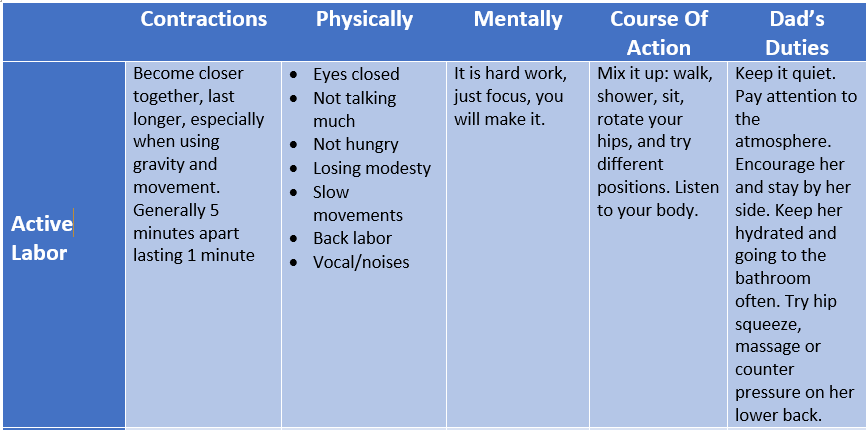
We learned that there are three stages of labor and delivery.


1st Stage: Pre-labor 


1st Stage: Early Labor


1st Stage: Active Labor


1st Stage: Transition


2nd Stage: Pushing Phase


3rd Stage: Delivery of the Placenta


Notes from our insturctor:

"The First Stage of Labor is the time when the uterus is contracting in order to open the cervix and let the baby descend. The basic mechanics of birth are virtually the same for all women. How everything plays out, in terms of duration, sensation, pain, time of onset of labor and virtually everything else varies greatly.

For this reason, part of class five is reading birth stories. You can find a link with over 100 birth stories here. Though the majority are positive, notice how very differently the women labor. Also notice the different choices they make from birth place to birth attendant, to natural birth or narcotic pain relief.

No matter how much we try to map and explain and predict labor, it simply can’t be done. Enjoy the beauty in the individual labor that you and your baby are given. Try to read a few birth stories a day to help prepare your mind for what happens in labor.

This link has a video showing what happens internally when the mother and baby labor together.

Relaxation Exercise: Flower Visualization

In “Deployment: Baby on the Move,” you learned about the process of labor. The image of a flower opening is very effective for a laboring woman. Focus on your breathing as you practice relaxation. The breath should come from deep in your abdomen. Women tend to be shallow, or chest, breathers. Breathing from your abdomen will influence how easily and effectively you are able to relax. Become aware of your breath this week, even in your daily activities.

Recipes that incorporate leafy green vegetables:

Breathing and relaxation exercises/Mindfulness Exercises:

Thursday, May 28, 2015

Birth Boot Camp: Class 4

We had our 4th class of Birth Boot Camp last week.

It was about the final prep for birth.

D-Day: noun – the day on which an important operation is to begin or a change to take effect. The last few weeks of pregnancy can be overwhelming – physically and emotionally. Know and understand various testing and procedures often done in the final weeks of pregnancy. Also included in the Countdown is planning your postpartum period, including breastfeeding support and finding a pediatrician. Understanding your options, you will be able to face the last few weeks of pregnancy with confidence and excitement.

The notes from our instructor really cover everything we talked about, but I do have to say that my favorite part was Bobby learning how to give a prenatal message! It was glorious! He has yet to give me another one though.

In order to prepare I have been trying to get my exercises done and our Doula said I should take a bath 3 times a week with music and try to focus on each muscle and relaxing it. The baby loves music and does not stop moving when it plays, so I'm not sure if we will be able to play music while I'm in labor, but the dark really helps relax.

Notes from our instructor:

"Final preparations! This is an exciting time but also a time often filled with many tests and sometimes results we may not be prepared for. Learning what these tests tell you and your options depending on the results is best to do now rather than later.

The GBS (also called Group B Strep or Beta Strep) test is a swab that tests for bacteria that is commonly present in the body. Treatment approaches vary and may range from IV antibiotics in labor to doing nothing at all and everything in between.

Sarah Buckley’s book Gentle Birth, Gentle Mothering has lots of good information, including some pertinent information regarding GBS and ultrasound. She is a doctor but very natural oriented and also points out how differently GBS is treated in different countries.

This article has some information about ultrasound and some of the benefits of keeping it to a minimum, including possible emotional benefits of avoiding it. (i.e. avoiding big baby scares, induction dates based on that, etc.) 

Vaginal exams in pregnancy are often NOT done in other countries. This post shares two stories of women and their emotional experience with the pregnancy vaginal exam.

Induction and induction agents are very common today in many hospitals, not just for women NOT in labor, but also for women who are already in labor to speed the process. This article by a midwife discusses the common happenings in a typical induction. You should know what will likely happen if you choose to go the induction route.

Discussed here are some of the risks and benefits of inducing labor. Keep in mind that there are always risks and benefits to every choice. Make choices that you feel most comfortable with and that you will feel best about in the future.

What is Pitocin? It is commonly used in labor and delivery both to begin or speed labor.

Here you can find the package insert for Cytotec, another common induction agent. (Note that it is approved for uses that DO NOT include induction).

ACOG (American College of Obstetrics and Gynecology) points out that a pregnancy isn’t considered overdue until after 42 weeks.

“What is post-term pregnancy? A post-term pregnancy is one that lasts 42 weeks or longer. Women who are having a baby for the first time or who have had post-term pregnancies before may give birth later than expected. 

However, the most common cause of postterm pregnancy is an error in calculating the due date. When a post-term pregnancy truly exists, the cause usually is unknown.”  Source found here.

Relaxation Exercise: Progressive Relaxation
Dads, you have learned a few massage techniques from Birth Boot Camp Massage Therapist Hannah Reasoner this week. Try using them as you read through this exercise. As you mention the various parts of the body, gently massage the tension away in those areas.

Here is the link to that article I mentioned that explains how the baby is the one who initiates labor:

This is the link to the article with more information about the Biophysical Profile and Non-stress test:

And finally, here is a long, detailed article about GBS:


*Disclaimer: This post in no way replaces the Birth Boot Camp class. All things in this post either came from the Birth Boot Camp website, are my insights or my instructors insights from class which have been appropriately cited. I am writing this post in order to help with future pregnancies, labors and deliveries. 

Tuesday, May 19, 2015

Birth Boot Camp: Class 3, Part 2

Part 2, of class 3 is all about who is in charge of your birth.

Chain of Command: noun – a series of ranks in which each has direct authority over the one immediately below. With so much birth lingo, it’s easy to get confused! Learn the difference between a doula and different types of midwives. How much influence does your insurance have in your birth? The people you choose to have present will affect your birth. The Chain of Command begins with you.

Of course the person who should be in charge of your birth is you and your partner, but a lot of times that isn't the case. It also depends on where you birth, going back to part 1, of class 3.

Hospital

If you birth in the hospital you are more likely to not be in charge of your birth. A lot of hospitals are not natural birth friendly which means they will require you to have an IV, have constant fetal and mother monitoring and make you stay in a bed. It is a lot harder to have a baby if you have to stay in bed, which can lead you to more likely get an epidural which give you a hire chance of have a cesarean. While this isn't the case for all deliveries, it is the case for a lot. 

Birth Center/Home Birth

In these two places you are much more in charge. You can be in charge in a hospital, but if your hospital and care provider aren't natural birth friendly you will most likely be fighting for what you want the whole time. If you are at one of these two locations you have a midwife who is all for natural birth and will do everything in their power to give you the birth you want, within the limits of safety. 

Who Should Be Present At Your Birth

A lot of people don't really think about this in depth like they probably should. Of course you will have your care provider and nurses, depending on where you birth, a Doula and Birth Photographer if you choose to hire them, but what about family members?

What about mom, mother-in-law, grandmothers and sisters? A lot of people will let all these people into their birth, which can actually make their labor longer and more stressful. If you see someone in pain, especially someone you really love, don't you want to do everything in your power to make them feel better? Wouldn't you get anxious when you realize you can't make them feel better? This is what tends to happen when you have the women listed above in your delivery. There have been studies that have shown the anxiety that these women have can actually effect your labor because you start to worry about them instead of birthing your baby. Of course some people have no problem with their family members being in there, but it is something you should really think about and talk to your partner about before you decide. 

Our decision was set from the beginning, Bobby and I were both on same page, thankfully. The only people allowed in our birth are our midwives, doula and us. We aren't even letting our family come to the birth center to see the baby. They have to wait until we get home, which will be around six hours after delivery. 

Post Delivery Family Visits

Most of the time you deliver the baby and an hour later you have your closest family and friends there to meet her. They pass her around and take a lot of pictures. This probably is not the healthiest thing for a new family if you want to start off on the right foot. Studies have shown that the first several hours after birth are the most important for bonding and establishing good breastfeeding. So, if you have those goals you might want to wait a few hours before introducing the baby to family. Because these are my goals, after she is born it will just be us at the birth center. We will do as much skin to skin as possible and really establish breastfeeding. That way she bonds with Bobby and I before others meet her. Assuming everything goes well, we will be able to go home around six hours after birth and family and friends can come to the house to meet her. 

A Doula

I mentioned a doula several times above, for those not familiar with doula they are someone you hire to support mom and dad and be their advocates during the birth process. They are especially important to have if you want a natural birth. While they are most important if you are having your baby in a hospital, they are very beneficial no matter where you decide to birth. They will help you navigate labor and help you get through the pain. They present you with all your options if there are complications and they are also available after birth to help with baby and postpartum care. 

We are so thankful we found our doula, Lindsay. Our personalities really clicked and I know she will help make our birth experience great!

Notes from our Instructor

"Having your body prepared for birth is incredibly helpful in getting the birth you want. Many midwives recommend chiropractic care and notice the difference it makes in speed of labor and positioning of the baby. You will find chiropractors certified to work with pregnant women here at the ICPA website. If there is not a chiropractor listed near you, a doctor that is familiar with or trained in the Webster Technique can be wonderful. Webster is a noninvasive technique that simply involves adjusting the pelvis and then doing muscle work on some of the ligaments that are near the uterus.

A doula can also be a fantastic tool. Many organizations offer certification, and your instructor may even be a working doula.

Prenatal Massage Therapy has become a highly sought after form of relief for common pregnancy related aches and pains.

Remember, in the end, you and only you are in charge of your birth!

Relaxation Exercise: The Waterfall

Both partners will participate in the Waterfall exercise. The side-lying position, or sleeping position, is still preferred as you are learning to deeply relax. Dads, listen for the slow pace of the exercise, allowing time to conjure up the image of the warm, relaxing waterfall. Remember to trade off during the week so you can hear how she wants you to read it."


If I wasn't such a researcher I know I would have been surprised by learning the above at our class. I could tell a lot of the other couples had never thought about these things. Just one of the many reasons an in-depth birth class is the way to go, especially for first time parents. 

*Disclaimer: This post in no way replaces the Birth Boot Camp class. All things in this post either came from the Birth Boot Camp website, are my insights or my instructors insights from class which have been appropriately cited. I am writing this post in order to help with future pregnancies, labors and deliveries. 

Monday, May 18, 2015

Birth Boot Camp: Class 3, Part 1

Birth Boot Camp Class 3 is divided up into two parts so I am also going to divide it up into two posts.

Part one is about choosing where to have the baby.

Setting Up Camp: verb – establishing your post. What should a couple look for when choosing a birth place? Whether you are planning to birth at home, at a birth center, or at a hospital, this class will empower you to know what questions to ask your care provider. Hear first hand some of the differences in various birth places. 

There are three options, hospital, birth center or at home. There are pros and cons to each and we actually made a list of the pros and cons. I'm not sure if I remembered all of them, but I tried my best.


I know there a lot of other pros and cons, but this what I can remember that we came up with. We chose a Birth Center at about 16 weeks along and we have really loved our midwives and the center.

Notes from our instructor:
"As you learned in class, where you choose to birth will impact how everything plays out.

If you choose to birth in the hospital, here is an article with some tips on how to do so successfully. Remember that choosing to birth in a hospital does not mean you can’t choose midwifery care. Many CNMs (certified nurse midwives) work in hospitals and may offer a more natural approach to your birthing care.

This link on finding a midwife has information on the legality of midwives in each state.

This article has information on the different types of midwives and how they vary.

Knowing the C-section rate of your hospital is excellent information. We would highly recommend not only checking on the rate of your hospital but also of your care provider. Be sure to ask them direct (but kind) questions relating to information you need for your birth. The Unnecessarean has a comprehensive list here of C-section rates by hospital throughout the country.

New Evidence confirms birth centers provide top-notch care!

This website has lists of birth centers by state, which are a great option also. Birth centers tend to be close to hospitals in case of transfer and sometimes work better for insurance reimbursement. Though often similar in safety to home birthing, a birth center may feel like a safe option for many couples."


*Disclaimer: This post in no way replaces the Birth Boot Camp class. All things in this post either came from the Birth Boot Camp website, are my insights or my instructors insights from class which have been appropriately cited. I am writing this post in order to help with future pregnancies, labors and deliveries. 

Tuesday, May 12, 2015

Birth Boot Camp: Class 2

We had our 2nd Birth Boot Camp class on May 7th. It was all about physical training and nutrition. 

P.T. & Chow: noun – physical training and food. Preparing your body – both inside and out — for the challenge of labor is exciting. Learn from a personal trainer how to properly tone the muscles you’ll need to birth your baby. Proper nutrition will help ensure a healthy baby and pregnancy. Following the nutritional program Birth Boot Camp teaches will give you a solid foundation in remaining healthy, strong, and low-risk. Finally, part of your Physical Training is the preparation of the mind, body, and spirit through relaxation practice in each class. Partners will learn helpful hints about the process of practicing relaxation at home. Taking P.T. & Chow seriously will pay off in the natural birth of your baby.

The first half of the class focused on nutrition. In summary you should aim to eat as much clean, unprocessed food as possible, with 80 grams of protein a day. This is easier said than done. It requires a lot of cooking because you can only prepare it in advance for a couple days before it starts tasting old. In the summer this will totally be possible for me, and is a possibility on the weekends, but during the work week it is a struggle. I have to track what I eat for 3 days this week with either the chart they provide in the workbook or using an app like My Fitness Pal, which I have used before. They also want to you to eat the rainbow as they call it, meaning lots of fruits and vegetables of all different colors. We even had to color a balanced meal for the day. This is what Bobby and I came up with, while its not labeled you can see all the different colors. 

The second half of the class we talked about physical training and even did some exercises to help with labor and delivery. They are all very simple and we are supposed to do them daily. We also did a relaxation exercise, but I didn't find it all the relaxing. The relaxing exercises I did in my high school theatre classes were better in my opinion. 

Here are some examples of the exercises we did, it explains how to do them and has pictures. I have done them every night, except 1, so far and I can already tell a difference in my muscle strength. 

Notes from our instructor:
"Labor and birth are endurance sports! This is not a sprint; it is a marathon. Preparing your body physically is often just as important as preparing your head and your emotions and your partner. Our modern and sometimes sedentary lifestyle means that many women have out of shape birthing muscles. This link has some tips and exercises that are safe for the pregnant woman. Remember to consult with your health care provider before beginning.

Many women are wondering, should I Kegel?  This article discusses the function of the pelvic floor, how to properly incorporate Kegels into your lifestyle and alternatives, if Kegels are inappropriate for you.

This post also has tips on healthy pregnancy snacks. Eating healthy snacks is key, and it is often where people make less healthy choices.  Rather than reaching for celery and peanut butter, they grab a bag of chips. Changing those habits is imperative to maximizing nutrients and healthy proteins.

Here is another link with healthy snacks.

This one has an entire day mapped out with non-meat protein for those who are vegetarian or just having a difficult time with meats.

This link from “Midwifery Today” has numerous articles on the importance of healthy eating during pregnancy.

Prepare now so that you can end your pregnancy healthy.

Relaxation Exercise: Tense/Release

Both partners will be practicing this exercise. You will each need two pillows — one for your head and the other for between your knees. If you have been receiving chiropractic adjustments, putting the pillow between your knees (not throwing your top leg over the pillow) will help “hold” the adjustment longer. Regardless, you will likely find this position to be quite comfortable. Choose a position that closely resembles your sleeping position, at least when you are starting to learn how to achieve deep relaxation.

The more you practice this Tense/Release exercise, the easier it will become. Quietly use this exercise at the beginning of each relaxation practice, quickly relaxing the muscle groups where you hold the most tension. This is the most basic of the relaxation exercises. Dads, practice and become comfortable with taking her through the exercise. Enjoy this special time together."

*Disclaimer: This post in no way replaces the Birth Boot Camp class. All things in this post either came from the Birth Boot Camp website, are my insights or my instructors insights from class which have been appropriately cited. I am writing this post in order to help with future pregnancies, labors and deliveries. 

Friday, May 1, 2015

Birth Boot Camp: Class #1


On April 30th we had our first class of our ten class Birth Boot Camp. 

According to the Birth Boot Camp website class one  is all about defining the mission of natural childbirth. 


We didn't do a whole lot on the first class. We talked about the different drugs used and the benefits and the drawbacks, along with the history of birth. Bobby was wondering when doctors became so obsessed with epidurals, because man there are a lot of drawbacks and side effects when using one. While sometimes they are necessary, for the most part the drawbacks overwhelm the benefits. I tried to do some research to find the answer, but I didn't have much luck. 

Here are some notes from our first class from our instructor:

"One thing we talk about in class one is the “Cascade of Interventions.” This brief article describes in depth some of the common interventions and how they can lead to unnecessary cesarean section when used without need.

Natural birth has also been shown to have a clear and measurable impact on breastfeeding success.  For those women planning on breastfeeding, preparing for a natural birth is an excellent way to increase their chances of success.

The next nine weeks will help prepare you for a natural birth. This article discusses some of the things you will learn and help you achieve your goal.

Demerol, Stadol, Nubain, and Fentanyl are all drugs commonly used for pain relief in labor.  They all have potential negative side effects.  Reading package inserts is a great way to familiarize yourself with common side effects of drugs used in labor before the birth."

*Disclaimer: This post in no way replaces the Birth Boot Camp class. All things in this post either came from the Birth Boot Camp website, are my insights or my instructors insights from class which have been appropriately cited. I am writing this post in order to help with future pregnancies, labors and deliveries.